
 Image 1 of 3
 Image 2 of 3
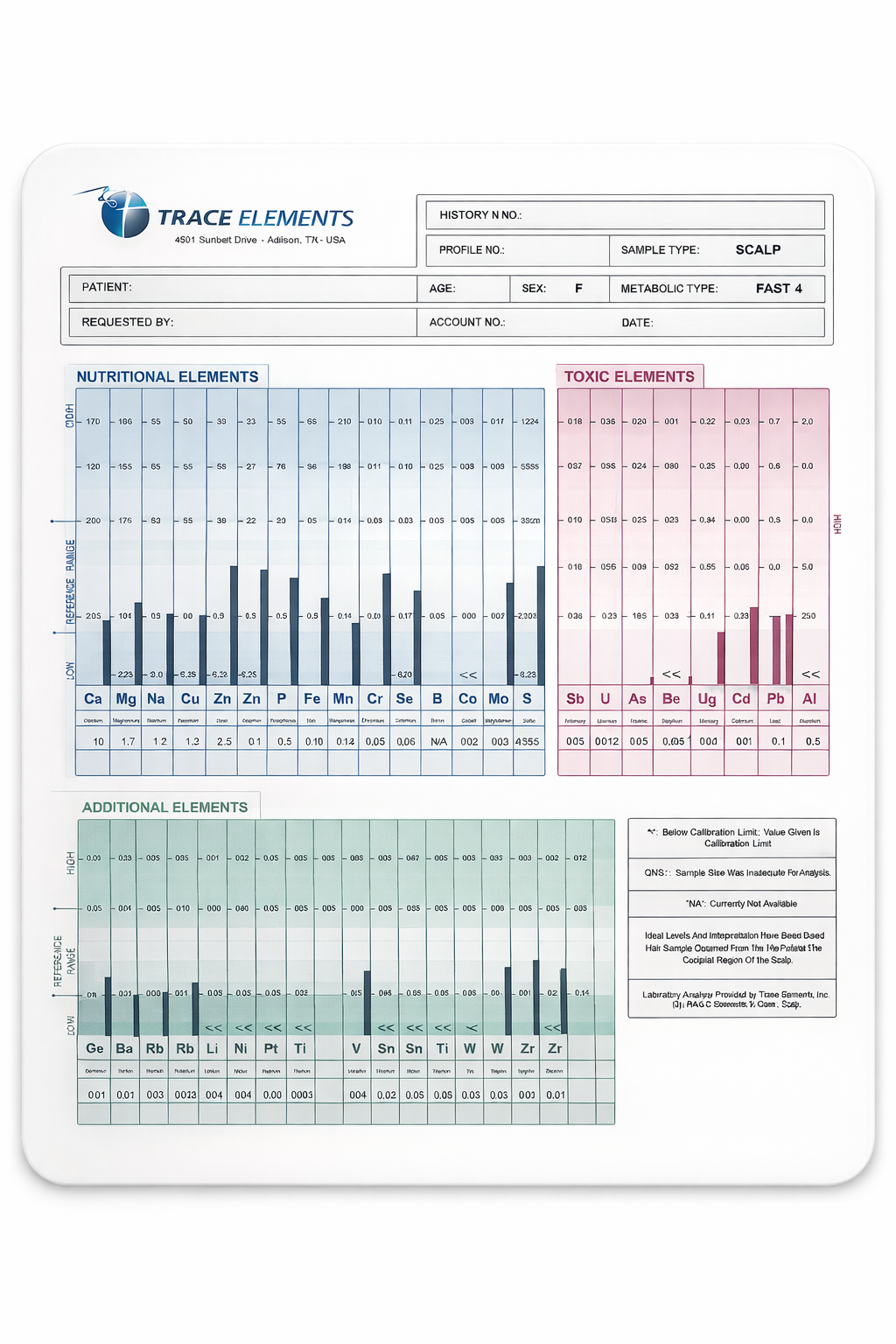 Image 3 of 3
Profile II – Laboratory Mineral Assay with Interpretation
This profile includes the full mineral test from Profile I, along with a detailed interpretation. It explains important mineral levels and ratios and how they relate to metabolism, energy, stress balance, and overall body chemistry. It also includes basic diet guidance and a personalized supplement plan to help restore balance.
After placing your order, you will receive a packet which will include everything you need to collect and send your hair to Trace Elements for testing.
Clients seeking further support in understanding their results can combine this service with an HTMA consultation, which includes a one-hour consultation with HTMA Practitioner, Rebecca Badge.
These minerals are vital for metabolism, hormones, nerves, bones, and energy production.
Common ones tested include:
Calcium (Ca) – metabolism, thyroid/adrenal balance, blood sugar trends
Magnesium (Mg) – stress response, muscle/nerve function
Sodium (Na) & Potassium (K) – adrenal function, fluid balance
Copper (Cu) – iron regulation, neurotransmitters, hormones
Zinc (Zn) – immune health, digestion, growth
Phosphorus (P) – energy production
Iron (Fe) – oxygen transport (storage trends, not anemia diagnosis)
Manganese (Mn), Chromium (Cr), Selenium (Se), Boron (B), Cobalt (Co), Molybdenum (Mo), Sulfur (S)
These values are often interpreted in ratios, not isolation.
These are heavy metals and environmental toxins that can interfere with enzymes, hormones, and nervous system function.
Typically includes:
Mercury (Hg)
Lead (Pb)
Cadmium (Cd)
Arsenic (As)
Aluminum (Al)
Uranium (U)
Antimony (Sb)
Beryllium (Be)
Less commonly discussed elements that can reflect environmental exposure or metabolic trends.
Examples:
Nickel (Ni)
Lithium (Li)
Tin (Sn)
Strontium (Sr)
Titanium (Ti)
Vanadium (V)
Tungsten (W)
Zirconium (Zr)
These are usually contextual, not diagnostic.
Trace Elements is known for interpreting:
Calcium/Magnesium – metabolic rate & thyroid trend
Sodium/Potassium – adrenal stress & resilience
Calcium/Potassium – thyroid trend
Zinc/Copper – immune, emotional, and hormonal balance
Na/Mg, Ca/Na, etc.
Profile II – Laboratory Mineral Assay with Interpretation
This profile includes the full mineral test from Profile I, along with a detailed interpretation. It explains important mineral levels and ratios and how they relate to metabolism, energy, stress balance, and overall body chemistry. It also includes basic diet guidance and a personalized supplement plan to help restore balance.
After placing your order, you will receive a packet which will include everything you need to collect and send your hair to Trace Elements for testing.
Clients seeking further support in understanding their results can combine this service with an HTMA consultation, which includes a one-hour consultation with HTMA Practitioner, Rebecca Badge.
These minerals are vital for metabolism, hormones, nerves, bones, and energy production.
Common ones tested include:
Calcium (Ca) – metabolism, thyroid/adrenal balance, blood sugar trends
Magnesium (Mg) – stress response, muscle/nerve function
Sodium (Na) & Potassium (K) – adrenal function, fluid balance
Copper (Cu) – iron regulation, neurotransmitters, hormones
Zinc (Zn) – immune health, digestion, growth
Phosphorus (P) – energy production
Iron (Fe) – oxygen transport (storage trends, not anemia diagnosis)
Manganese (Mn), Chromium (Cr), Selenium (Se), Boron (B), Cobalt (Co), Molybdenum (Mo), Sulfur (S)
These values are often interpreted in ratios, not isolation.
These are heavy metals and environmental toxins that can interfere with enzymes, hormones, and nervous system function.
Typically includes:
Mercury (Hg)
Lead (Pb)
Cadmium (Cd)
Arsenic (As)
Aluminum (Al)
Uranium (U)
Antimony (Sb)
Beryllium (Be)
Less commonly discussed elements that can reflect environmental exposure or metabolic trends.
Examples:
Nickel (Ni)
Lithium (Li)
Tin (Sn)
Strontium (Sr)
Titanium (Ti)
Vanadium (V)
Tungsten (W)
Zirconium (Zr)
These are usually contextual, not diagnostic.
Trace Elements is known for interpreting:
Calcium/Magnesium – metabolic rate & thyroid trend
Sodium/Potassium – adrenal stress & resilience
Calcium/Potassium – thyroid trend
Zinc/Copper – immune, emotional, and hormonal balance
Na/Mg, Ca/Na, etc.